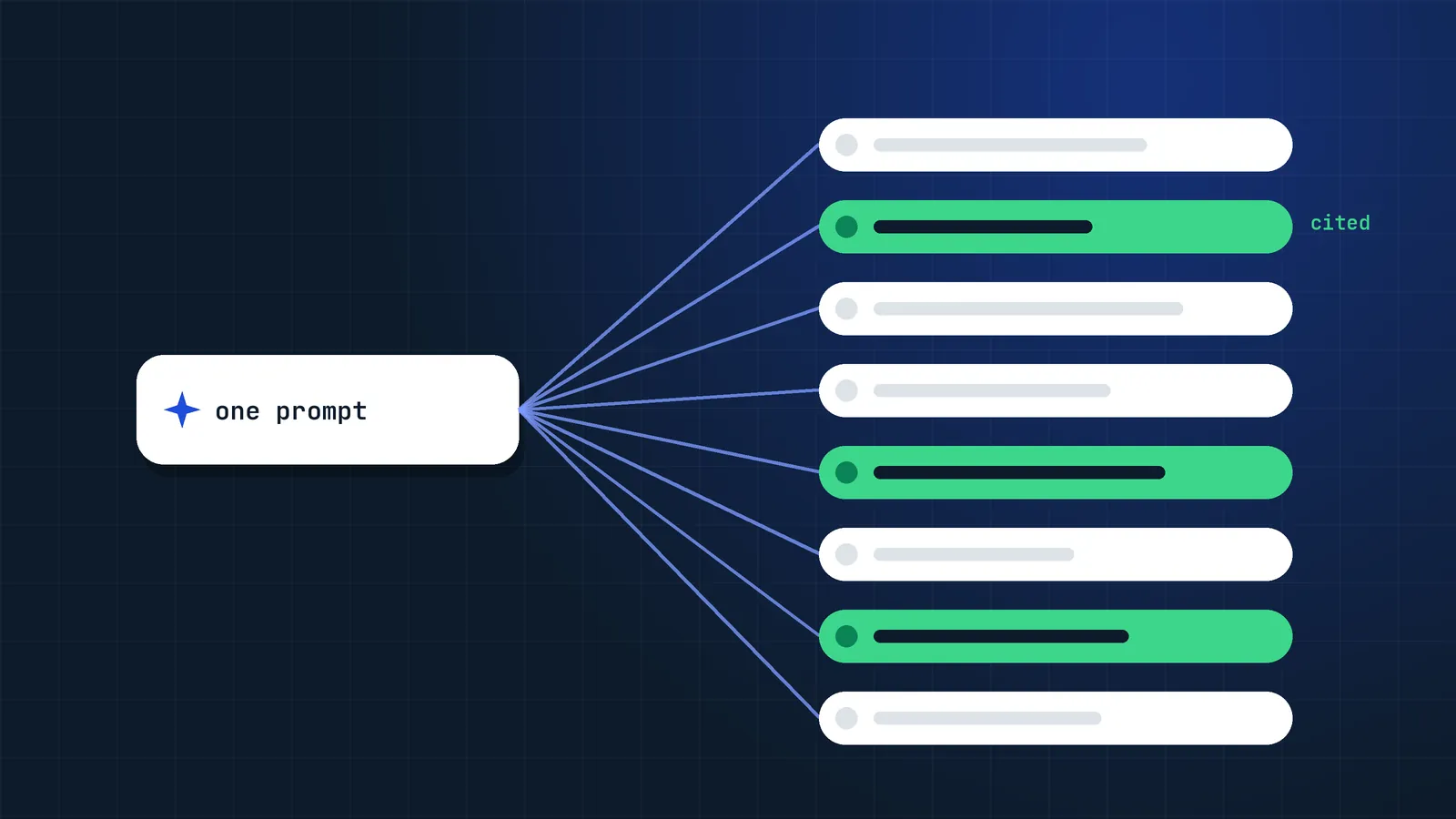
Type "best running shoes for flat feet under $150" into Google AI Mode and the system may not run just that one search. It can run several related ones, such as "running shoes for overpronation", "stability vs motion control shoes" or "running shoe price comparison" (illustrative examples), then use the results to write one response.
That process is called query fan-out, and it changes what "optimising for a keyword" means.
What is query fan-out?
Query fan-out is a retrieval technique where an AI search system breaks a user's prompt into several related sub-queries, runs them in parallel, and synthesises the results. Google explains it in its AI optimization guide, and Search Console Help describes AI Mode as grouping the user's question into subtopics and searching for each one simultaneously.
An April 2026 research paper by Anthony Lee on SSRN describes the same pattern across AI platforms: fan-out queries decide which pages are fetched, which enter the model's context window, and which get cited in the final answer.
How many sub-queries?
Measurements vary by platform and method:
| Platform | Reported sub-queries per prompt | Source |
|---|---|---|
| Google AI Mode | 8 to 12 is commonly cited | Third-party estimates (Google publishes no number) |
| Gemini 3 | About 10.7 on average | Seer Interactive |
| ChatGPT | About 2.3 to 2.8 | Peec AI |
These are third-party measurements, not official figures, so treat them as directional. The important part is the pattern: one visible question, several invisible searches.
Prompts are also getting longer. In its Q3 2026 earnings remarks, Google said AI Mode queries are on average three times longer than traditional searches, and one in five AI Mode searches uses voice, images or documents. Longer, richer prompts give fan-out more angles to search for.
Why does query fan-out change SEO?
Because the answer is built from several searches instead of one, visibility depends on how well your site covers the questions around a topic, not on a single ranking. Four consequences follow.
1. The best answer can come from deeper in the results
Because the response draws on several searches, a page that ranks seventh for the main query can be cited for one specific point ahead of the page in position one. Google also says its systems can pick out the relevant part of a page that covers several topics.
2. Coverage beats a single keyword
If your site genuinely covers the questions people have around a topic, it has more chances to be useful in an answer. That is a reason to build real expertise across a topic, not to mass-produce pages: Google says that creating separate content for fan-out variations primarily to manipulate rankings violates its scaled content abuse policy.
3. Rankings for "invisible" queries matter
Many related searches are long and specific, and they rarely show up in keyword tools. Google says its AI systems understand synonyms and meaning, so you do not need to chase every long-tail variation; you need pages that answer the underlying questions well.
4. The top 10 is less of a guarantee
Some third-party analyses in 2026 reported that a smaller share of AI Overview citations came from the classic top 10 for the main query. The numbers are debated, but it matches what I see in AI search audits: strong pages ranking deeper still get cited.
How should you optimise for query fan-out?
Google's own advice is short: there is no special optimisation for its AI features beyond good SEO and helpful, original content. The steps below are about understanding your audience's questions, not about producing pages for each one.
Step 1: Understand the questions behind a topic
For each priority topic, collect likely sub-queries from:
- People Also Ask and "related searches".
- The follow-up suggestions and "dive deeper" links shown in AI Mode.
- Long queries in Search Console (filter for queries with 7+ words or containing "how", "vs", "best", "for").
- Sales calls, support tickets and on-site search.
- Asking an AI assistant: "What would you search to answer [prompt]?" It is not exact, but it surfaces angles you missed.
Group them into intents: definitions, comparisons, costs, steps, risks, alternatives, best-for scenarios.
Step 2: Check your existing pages answer them
A simple map shows where an important question is answered badly or not at all:
| Sub-query | Best page | Section heading | Status |
|---|---|---|---|
| stability vs neutral running shoes | /guides/running-shoe-types/ | "Stability vs neutral shoes: which do you need?" | Exists, answer buried |
| running shoes flat feet price range | /flat-feet-running-shoes/ | "How much should you spend?" | Missing |
Improve existing pages first and create a new page only when the intent is clearly different and the page would be useful on its own. Do not create near-duplicate pages for each phrasing.
Step 3: Write clearly for readers
This is good editorial practice rather than an AI trick (Google says you can ignore "chunking"):
- Use a descriptive heading that mirrors the sub-query in natural language.
- Give the direct answer early, then the detail.
- Add specifics: numbers, named examples, conditions ("if X, then Y").
- Keep sections focused, so readers can scan to what they need.
- Use lists and tables for steps and comparisons.
Step 4: Connect the cluster
Link related pages with descriptive anchor text, add a hub page for the topic, and make sure every important page is reachable within a few clicks from strong pages. Internal links help crawlers discover the whole cluster and help Google understand which page answers which question.
Step 5: Add what the consensus lacks
When ten sources say the same thing, AI systems can use any of them. Give them a reason to use yours: original data, first-hand testing, expert commentary, a clear framework or a decision table.
Step 6: Keep pages technically accessible
Passages must be in the rendered HTML, not hidden behind tabs that load on click, infinite scroll, or client-side scripts that crawlers struggle with. Use clean heading hierarchy (h2, h3) and avoid putting key answers only in images.
What does query fan-out look like in practice?
Prompt: "Is it worth migrating from Magento to Shopify for SEO?"
Likely sub-queries: Shopify SEO limitations, Magento vs Shopify URL structure, redirect handling on Shopify, migration traffic loss risk, Shopify Plus SEO features, migration checklist.
A site that wants to be cited should answer these well, without a separate thin page for each: a comparison page, a page on Shopify URL constraints (/products/ and /collections/ paths), and a site migration checklist.
How do you measure the impact of query fan-out?
Measure fan-out through three signals: AI impressions, long-tail rankings and monthly citation checks.
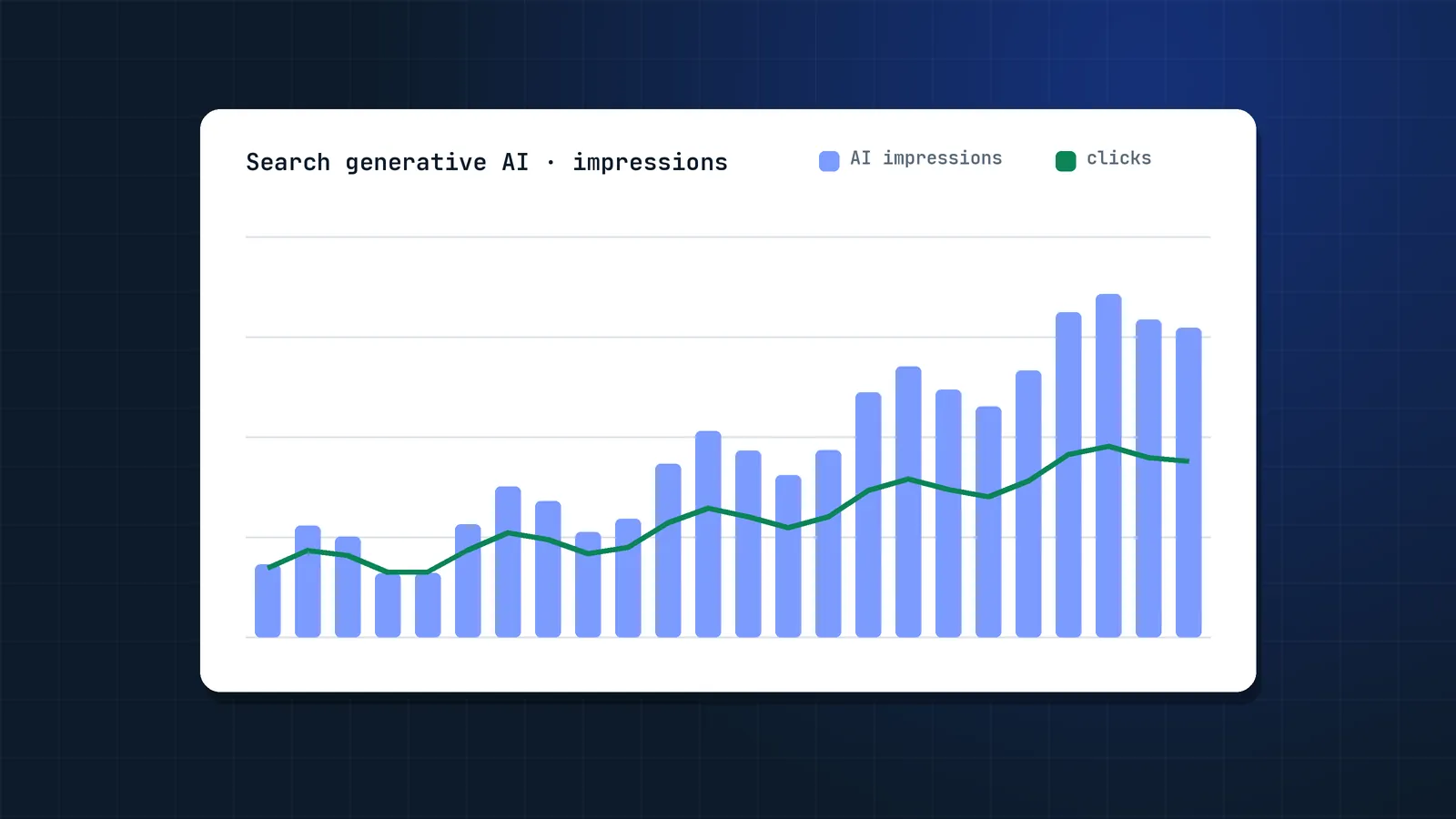
- Track impressions in Search Console's Generative AI performance report for the pages you restructured.
- Monitor rankings for long-tail sub-queries, not only head terms.
- Run your prompt set in AI Mode and ChatGPT monthly and log which pages get cited.
- In Bing Webmaster Tools, the AI Performance report shows the "grounding queries" Copilot used when it cited your pages. That is the closest thing to real fan-out data any search engine publishes.
FAQ
What is query fan-out in simple terms?
It is when an AI search tool turns your one question into several smaller searches, looks at the results for each, and combines the best pieces into a single answer. It is how AI Mode and similar tools cover different angles of a question at once.
Does query fan-out mean keywords no longer matter?
Relevance still matters, because each related search returns ranked results. But Google says its AI systems understand synonyms and meaning, so you do not need every keyword variation. Focus on clearly answering the real questions behind a topic.
Do I need to split content into short chunks for AI?
No. Google's AI optimization guide says there is no requirement to break content into tiny pieces, and that its systems can understand multiple topics on one page and show the relevant part. Write for readers; shorter or longer pages can both work.
Should I create a separate page for every sub-query?
No. Google says creating separate content for fan-out variations primarily to manipulate rankings violates its scaled content abuse policy. Answer related questions within strong pages, and create a new page only when the intent is clearly different.
Can I see which sub-queries Google used?
Not directly. Google does not show fan-out queries in Search Console. You can infer them from People Also Ask, AI Mode follow-up suggestions, long-tail queries in Search Console and the sources cited in answers. For Microsoft Copilot, Bing Webmaster Tools' AI Performance report does list the grounding queries behind your citations.
Do ChatGPT and Perplexity use query fan-out too?
Yes. Third-party tests show ChatGPT running about two to three web searches per prompt when search is triggered, and Perplexity also searches several angles before answering. Google AI Mode and Gemini tend to run the most sub-queries.
Is query fan-out the same as People Also Ask?
No, but they are related. People Also Ask shows questions users commonly search next. Query fan-out is the hidden set of searches an AI system runs to build one answer. People Also Ask is one of the best public clues to what those hidden searches look like.
Sources
- Google's guide to optimizing for generative AI features on Google Search, Google Search Central
- What are impressions, position, and clicks? (AI Mode), Search Console Help
- Spam policies for Google web search: scaled content abuse, Google Search Central
- How AI platforms search: fan-out query behavior across intent types, verticals and platforms, Anthony Lee, SSRN
- WTF is "query fan-out" in Google's AI Mode?, Digiday
- Query fan-out guide, NoGood
- Q3 2026 earnings call: remarks from our CEO, Google (Oct 28, 2026)
- Introducing AI Performance in Bing Webmaster Tools (public preview), Bing Webmaster Blog (Feb 2026)